

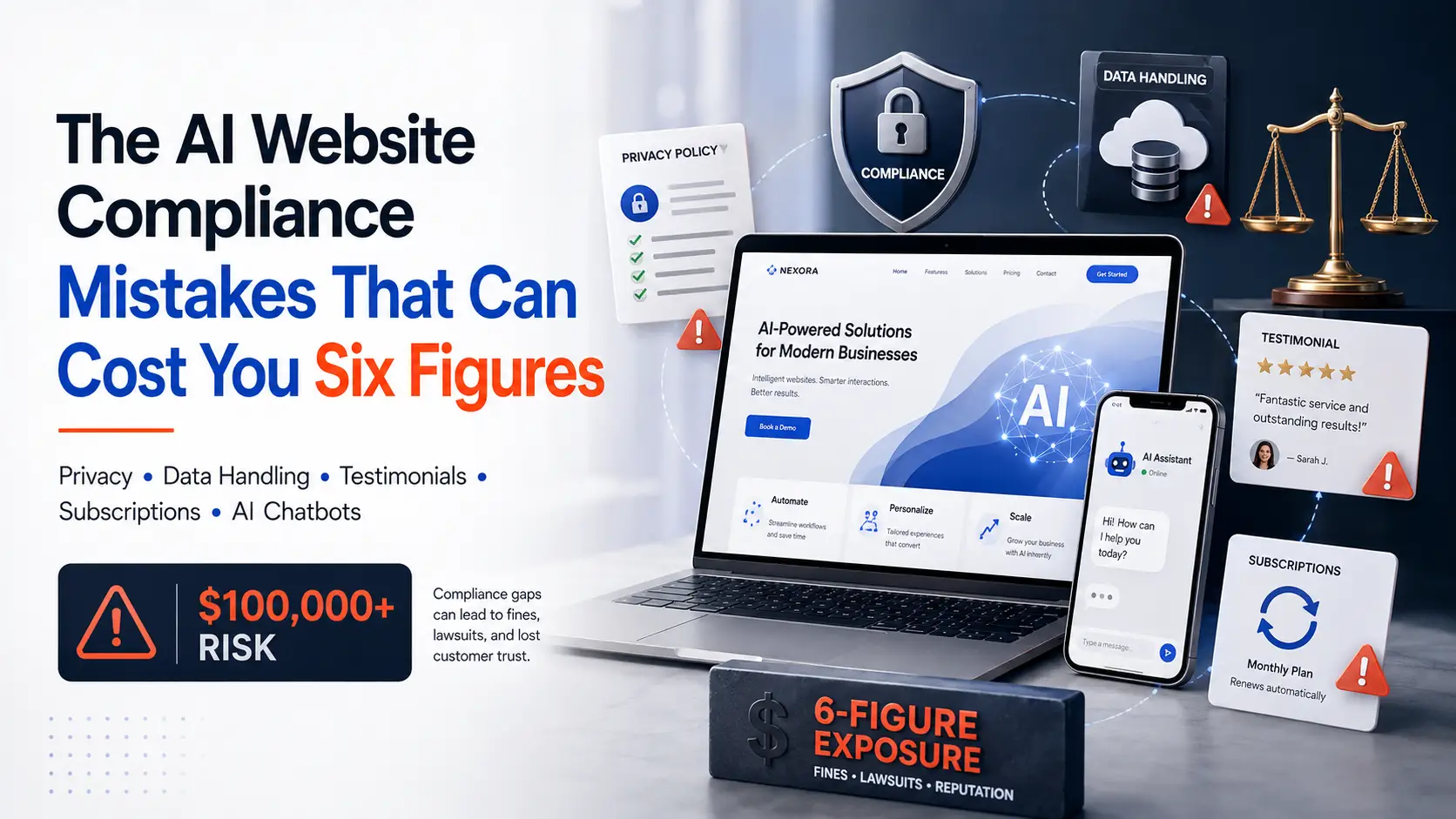
You can now take an app from prompt to production in a weekend. What you cannot do is prompt your way out of consumer protection law. Regulators do not have a “vibe coded” exemption, and the penalty math on a shipped-but-non-compliant AI website adds up faster than most builders realize. Stack a missing privacy policy, a few borrowed testimonials, and a cancellation flow that fights the user, and you are staring at a six-figure exposure on an app that took two days to build.
The tools compressed the build phase. They did not compress the liability. Every one of the gaps below is something AI builders skip because the platform never forces them to think about it, and every one of them carries a real statutory number behind it. Here is where the money leaks, grouped by the law that comes after you.
This is a practitioner’s compliance checklist, not legal advice. For anything with real exposure, run it past an attorney before launch.
Privacy Policy Failures: The CCPA Baseline Almost Everyone Misses
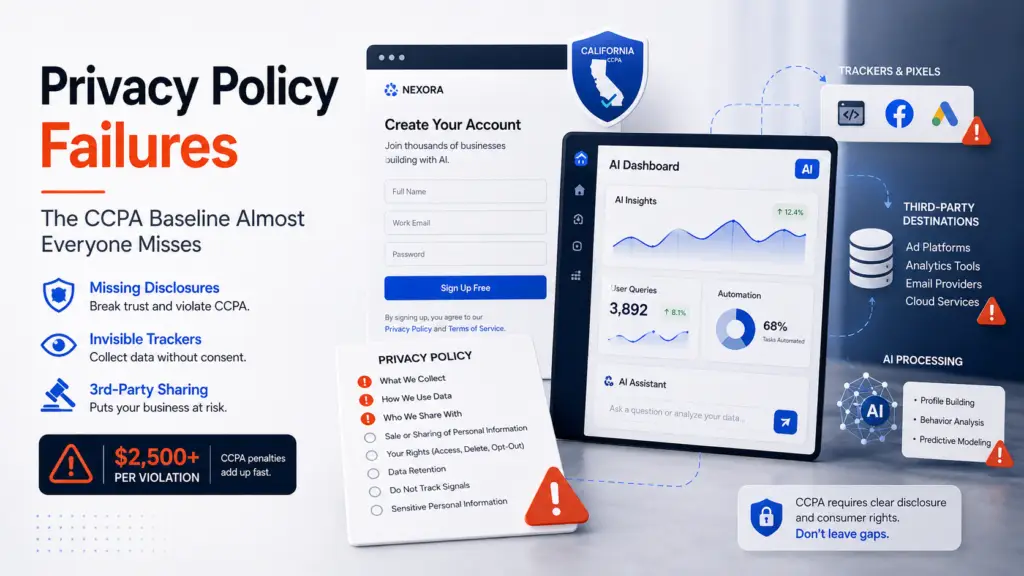
The most common failure is also the cheapest to fix. Under the California Consumer Privacy Act as amended by the CPRA, businesses that collect personal information from California residents face civil penalties of $2,500 per unintentional violation and $7,500 per intentional violation, and California adjusts those figures for inflation. Critically, “per violation” can mean per affected consumer. A thousand users touched by the same gap is not one fine.
Four privacy policy gaps show up constantly in AI-built apps:
- No privacy policy at all. Lovable, Bolt, and Cursor will happily ship you a production app with a signup form and zero legal pages. If you collect an email address, you are collecting personal information, and you need a policy before the first user signs up.
- No disclosure that you collect user data. A privacy policy that exists but does not actually state what categories of data you collect, why, and how long you retain it is functionally the same as not having one. Vague boilerplate does not satisfy CCPA disclosure requirements.
- No disclosure of AI processing. If user inputs are being sent to OpenAI, Anthropic, or any other model provider, that is data processing your policy needs to name. Users typing into your chat feature are handing data to a third party they have never heard of, and regulators increasingly treat undisclosed AI processing as a material omission.
- No disclosure of third-party data collectors. Your analytics stack, your pixel, your session recorder, your error logger. Every vibe-coded app ships with three to six third-party scripts the builder never audited. Each one collecting data your policy does not mention is another disclosure failure.
The fix for all four is a single working session: inventory every service that touches user data, including the AI providers, and write a policy that names them. Then keep it current when you add a tool, because the policy that was accurate at launch and wrong by month three is still a violation.
Data Handling: The $750-Per-User Problem
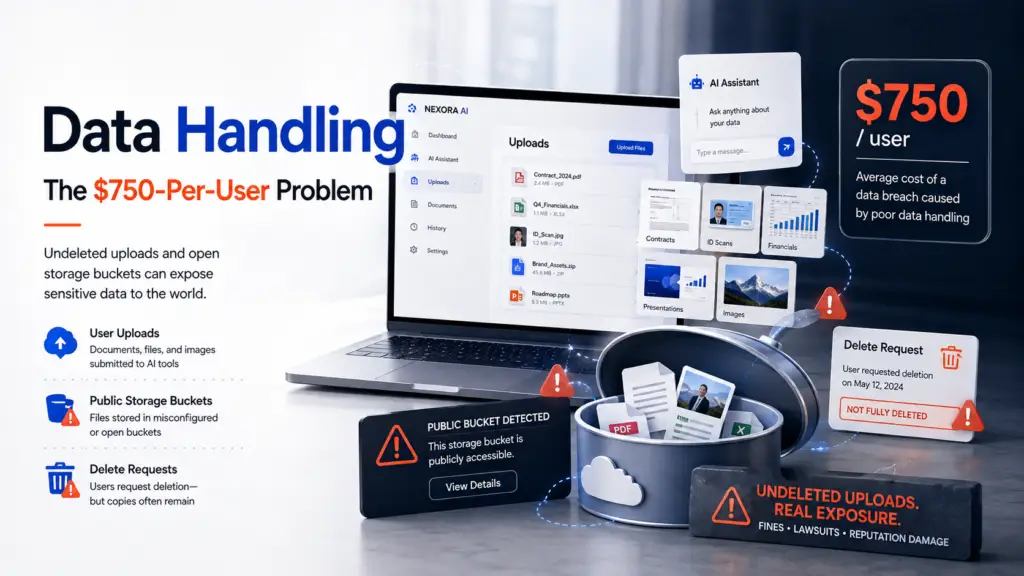
The CCPA gives consumers a private right of action when their data is exposed through inadequate security, with statutory damages of $100 to $750 per consumer per incident. No lawsuit needs to prove actual harm at the statutory floor. That per-consumer multiplier is what turns a sloppy backend into class action bait.
Two data handling failures dominate in AI-built apps:
Not deleting user uploads. Users have a right to deletion under CCPA, and “we never built a delete function” is not a defense. If your app accepts uploads, whether documents, photos, or voice notes, you need a working path to purge them on request and a retention schedule that purges them eventually regardless. AI builders almost never generate this unless you explicitly prompt for it.
Public storage buckets. This is the classic vibe coding failure mode. The AI scaffolds a Supabase or S3 bucket, defaults it to public so the demo works, and nobody ever flips it. Every user upload is now enumerable by anyone with the URL pattern. That is not a hypothetical breach risk; it is an active exposure of consumer data, and it is discoverable by any security researcher with an afternoon. Check your bucket policies and row-level security before launch, not after the disclosure email.
Fake Testimonials: The Single Most Expensive Line on This List
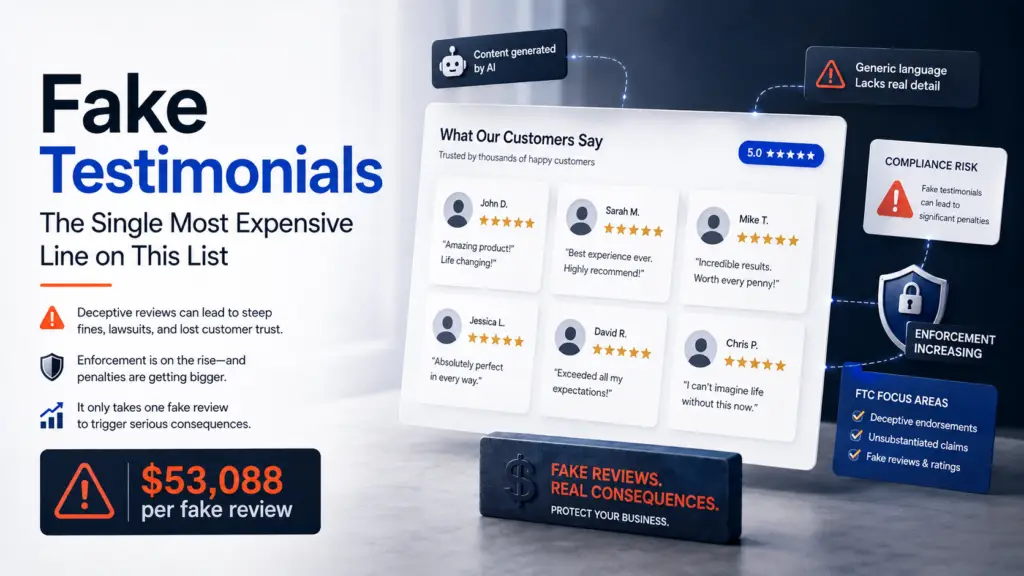
The FTC’s Rule on the Use of Consumer Reviews and Testimonials took effect in October 2024, and it carries civil penalties of up to $53,088 per violation as of 2026, with each fake review potentially counting as its own violation. The FTC began sending enforcement warning letters in late 2025 and filed its first Rule-based actions in 2026. This is no longer a theoretical rule waiting on enforcement priorities.
The trap for AI builders is that fabricated social proof is a default output. Ask any AI builder for a landing page and it generates a testimonials section populated with “Sarah M., Austin, TX” and a five-star quote from a customer who does not exist. Ship that, and you have published fake testimonials under a rule with a $53,088-per-violation ceiling. AI-generated reviews are explicitly covered.
The fix costs nothing: delete the placeholder testimonials before launch, and only publish quotes from real customers you can document. If you have no customers yet, run without a testimonials section. An empty social proof block has never bankrupted anyone.
Subscription Mechanics: Cancellation Symmetry and Renewal Reminders
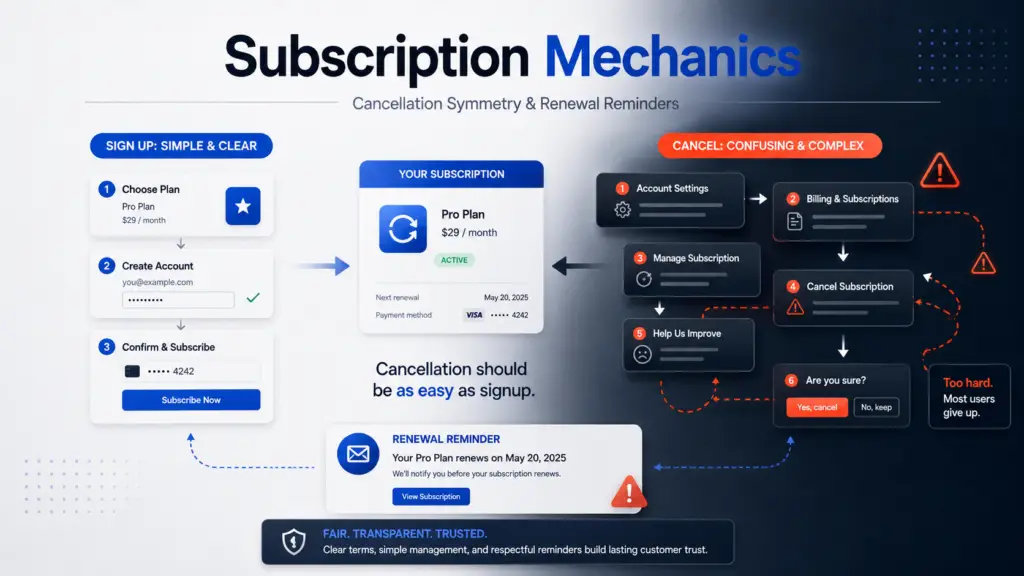
If your app charges a recurring subscription, state automatic renewal laws apply, and California’s Automatic Renewal Law is the strictest of them. The operating principles: cancellation must be at least as easy as signup, in the same medium, and consumers must receive clear renewal terms and, in many cases, advance reminder notices. The remedy exposure is what makes this category dangerous. When a business fails to comply, goods and services delivered under the non-compliant subscription can be treated as an unconditional gift, which in practice means full refund exposure across your entire subscriber base, plus the class action bar that actively hunts these cases.
Two specific failures to check in your own flow:
Cancellation takes longer than signup. If signup is one form and cancellation is an email to support, a retention call, or a buried settings page behind four clicks, you fail the symmetry test. Build the cancel button into the account page and make it work in one session.
Auto-renewal without reminder. Silent renewals, especially on annual plans and after free trials that convert to paid, are the exact pattern these statutes target. Send the renewal reminder email with the amount and the cancellation link. Stripe and every major billing platform can automate this; the failure is never technical, it is that nobody turned it on.
AI Chatbot Liability: The Newest Exposure
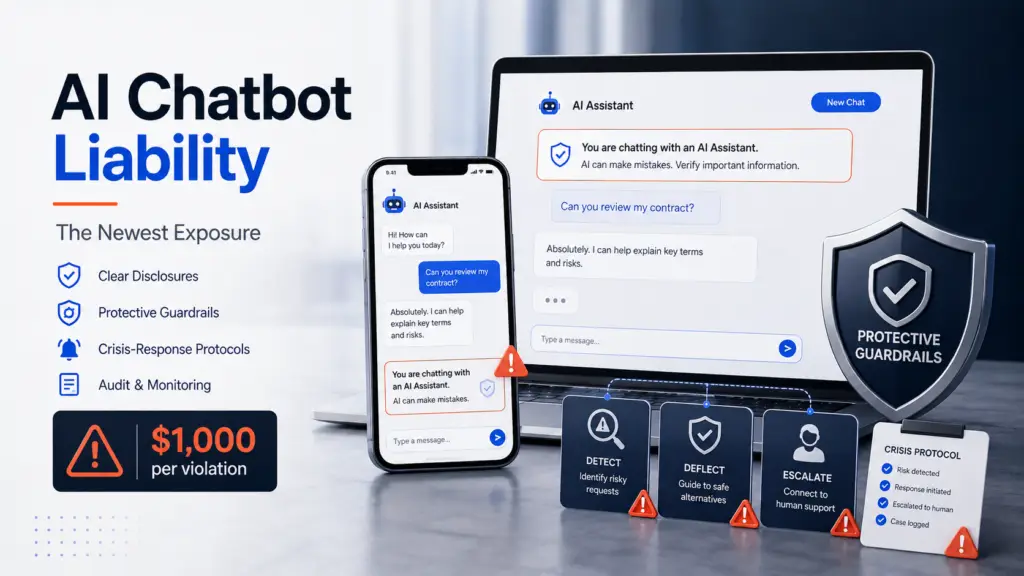
If your product includes a conversational AI feature, you now have obligations no website owner had two years ago. California’s SB 243, effective January 1, 2026, requires operators of companion chatbots to maintain published protocols preventing the production of suicidal ideation and self-harm content, to refer users expressing crisis to crisis services, and to disclose that users are talking to AI. It carries a private right of action with damages of the greater of actual damages or $1,000 per violation, plus attorney’s fees, and similar laws are already live or incoming in New York, Oregon, and Washington.
The scope question matters: a pure customer service bot is generally excluded, but the more human-like, relationship-sustaining, and open-ended your chat feature is, the closer it sits to the covered category. Most vibe-coded AI apps wire a raw model API into a chat window with no system prompt guardrails, no crisis response, and no AI disclosure. That is the exact configuration the statute was written for. At minimum: disclose that it is AI, implement and publish a self-harm response protocol that surfaces crisis resources, and log that the safeguards fire.
The Pattern Behind All Ten
Every failure on this list shares one cause: AI builders optimize for a working demo, and compliance is invisible in a demo. The privacy policy, the bucket permissions, the delete function, the renewal email, the chatbot guardrails. None of them affect whether the app looks finished, so none of them get built unless someone deliberately builds them.
The compliance pass on an AI-built app is a half day of work: legal pages that reflect reality, a data inventory, locked-down storage, real testimonials or none, symmetric cancellation, renewal notices, and chatbot safeguards if you have a chat feature. Against penalty structures that run $750 per user, $1,000 per violation, and $53,088 per fake review, it is the highest-ROI half day in your entire launch checklist.
Frequently Asked Questions
Does a small AI-built app really need a privacy policy?
Yes. Privacy laws apply based on what data you collect, not how big you are or how the site was built. If your app collects emails, names, uploads, or usage data from users, disclosure obligations attach from the first user. Small revenue thresholds exempt some businesses from CCPA specifically, but other state laws, platform terms, and FTC deception standards still apply.
Are AI-generated testimonials actually illegal?
Publishing testimonials from people who do not exist or who never used your product violates the FTC’s Consumer Review Rule, and AI-generated reviews are explicitly covered. Penalties can reach $53,088 per violation, and each fake review can count separately. Delete placeholder testimonials before you ship.
What is the fastest way to check if my storage bucket is exposed?
Open an incognito browser and try to access a user-uploaded file’s direct URL without being logged in. If it loads, your bucket is public. In Supabase, review bucket policies and row-level security; in S3, check Block Public Access settings. This takes ten minutes and closes one of the largest single exposures on this list.
Do chatbot safety laws apply to a simple support bot?
Generally no. Laws like California’s SB 243 target companion chatbots that sustain human-like, relationship-oriented interactions, and bots used solely for customer service are excluded. But the line is behavioral, not labeled: an open-ended assistant that users treat conversationally can drift into covered territory. Adding an AI disclosure and a crisis-response fallback is cheap insurance either way.
Can I fix these issues after launch, or is the damage done at ship?
Fix them immediately either way. Liability accrues while the violation is live, so every day non-compliant adds exposure, but prompt remediation matters enormously in both regulatory discretion and litigation posture. An app that fixed its gaps in week two looks very different from one that ignored them for a year.
Final Thoughts
AI builders removed the technical barrier to shipping software. They did not remove the legal one, and the gap between those two facts is where builders are getting hurt. None of the ten failures above require a lawyer on retainer to prevent. They require knowing they exist and spending a half day closing them before launch instead of six figures after.
If you are shipping AI-built apps or websites for your business and want the compliance pass handled alongside the build, that is work worth doing once, properly, before the first paid user hits the flow.


